In my younger years, I worked as a life guard. After closing, we would put the flexible pool covering over the water and have contests to see how far we could run before sinking - the technique that worked w. it (running "lightly" with quick feet) seems to be what they are using here. We never thought to actually try it on bare water!!! Amazing. :)
Wednesday, May 26, 2010
Walking On Water
Thank you to Tom Furman for posting this to a forum I frequent.
In my younger years, I worked as a life guard. After closing, we would put the flexible pool covering over the water and have contests to see how far we could run before sinking - the technique that worked w. it (running "lightly" with quick feet) seems to be what they are using here. We never thought to actually try it on bare water!!! Amazing. :)
In my younger years, I worked as a life guard. After closing, we would put the flexible pool covering over the water and have contests to see how far we could run before sinking - the technique that worked w. it (running "lightly" with quick feet) seems to be what they are using here. We never thought to actually try it on bare water!!! Amazing. :)


Monday, May 24, 2010
Training With Distraction
It's not a bad idea to train with distraction from time to time. The distraction can come from within or from without. Tonight it was both, but I managed to put in a little time and it was all good. Light weights, but a good session.
Saturday, May 22, 2010
How Many Certs Does It Take?

Sometimes I wonder "how many certs does it take"?
I mean... is there truly a need for an endless string of letters after your name? Does it make a trainer or coach more marketable? Is it a guarantee of competence? Will someone with a certification that is, for example, something acquired by a paper or online test, or over a weekend, be that much better, or better at all than someone without? Do YOU need a certification (or two, or three)?
The honest answer to those questions is "it depends". Understand that I am NOT anti-certification. I'm all for professional development and think EVERY coach or trainer should actively seek out others in the field to share with and learn from. I am an RKC and quite satisfied with the organization as a whole. A certification from a reputable organization is like a letter of recommendation and a guarantee of minimal competence which are critical if you don't know the person whom you are hiring. Gym chains often have specific requirements for their hires. If you are trying to get some experience, then certifications are going to help you get your foot in the door. If a potential client can't distinguish one golf shirt from another, then the golf shirt with the most letters behind his/her name is going to win.
Eventually, however (and the higher you climb) the success of your resume' is going to come down to NOT what you've attended or studied, but what you've accomplished, who you've worked with, who you've coached, and what you've produced. Do your skills match the needs the of the client and have you demonstrated that well enough to be hired? Ultimately, whether YOU need a particular cert or not depends on goals and resources...
If you are looking for kettlebell instruction from a very competent trainer and coach and you are in the Colorado area, look no further than Randy Hauer's (former RKC Team Leader and AKC Coach) Free Kettlebell Certification. Certainly can't beat the price and Randy's a stand-up guy and has trained athletes of all kinds including Girevoy (kettlebell) Sport champions.
Thursday, May 20, 2010
Skwat! T-Shirts
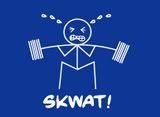
I have three XL-sized "Skwat!" t-shirts. Only three.
How about $25 for one, or $50 for all three?
If you want one, or all three, shoot me an email. Payment will be through PayPal.
First come, first served.
Sunday, May 16, 2010
Extremity Training - The Missing Link

When I was young, my father often talked about research the Soviets did with weightlifters using a dynometer which showed a high correlation between grip strength and a lifter's success or failure on the competition platform. Lifters who had poor grip strength prior to an snatch or clean and jerk attempt would very likely miss their attempts and if their grip was strong, they were likely be successful.
Surprising? No. A good grip can be an indicator of many things, including excitability and proper rest - it only makes sense that a competitor, sufficiently rested and psyched up will perform well on a grip strength test and likewise perform well on the platform. However, it can point the way to other things as well, such as the importance of having a strong grip.
Jedd Johnson of the Diesel Crew said on the Dr. Squat message boards (many years ago now) something to the effect of "a strong grip = a strong EVERYTHING". I don't know if that's true all the time, but it is certainly true that a weak grip can ruin all kinds of performances that would otherwise be very strong. For example, in the fighting arts, such as wrestling, judo, and jujutsu, NO ONE becomes good with a weak grip and neck. Have you ever heard of a weak-wristed striker? And a strong deadlift does not exist without a grip to match the posterior chain.
A point light figure like in the picture below, immediately highlights many structures that are regularly neglected in training, namely the neck, the wrist and hands, the hips, and the ankles and feet.

Any injury is bad, of course, and everything is interconnected, but we can work around some injured areas more easily than others. All of the areas highlighted above, when injured, can completely incapacitate us. A bad shoulder or hamstring and we can somehow manage, but injure an ankle or dominant hand and we are in a world of hurt.
So what? The bottom line is that if the only exercise a trainee does in the gym for the lower body is set after set of badly performed barbell back squats, then we're leaving a lot to be desired. Power generated from "the core" will not be expressed if dampened by weak and soft end points. The inclusion of exercises that stress and strengthen the extremities (at least on an occasional basis) are an absolute necessity for any program that claims to be "functional". This doesn't mean an additional half dozen isolation exercises - hill sprints and heavier sandbag work will cover most things. But, they need to be included.
Saturday, May 15, 2010
I Just Posted This To A Forum (and thought it was worth sharing...)
Full Squats = High Bar Position
If you are doing "full" squats (atg, ata, etc) then, preferably, you should be using a high bar position. At the very bottom of the hole, the hips move forward to achieve full flexion and if you are using a low bar placement, then the back must flex to keep the bar's center of gravity over your foot.
Long story short (IMHO):
*Low bar position = parallel or below parallel, hips move back
*High bar position = full squat, hips move vertically
Related Posts:
Squatting and Lower Back Pain (Part I)
Squat Rx #21 ("Hips Back")
Friday, May 14, 2010
Not What I Wanted...
I was having a bad day mood-wise. Probably a combination of too much caffeine and not enough sleep.
Lifting felt good, but as I gripped the barbell to start a set of Romanian deadlifts with a weight probably 100lbs less than I would have been using a decade ago, a thought crept into my consciousness - "I'm weak. This is a child's weight. I should be stronger." I quickly put it out of my mind with the realization that a 100lbs difference, in the grand scheme of things, is not significant, and that what I did a decade ago has NO bearing on what I am and what I am doing right here, right now.
None whatsoever.
Often in training and in life we wish things were different. We think "This is not what I wanted". We think "It should be different".
Well, it really IS what it is - we make things worse by wishing it really is not what it is when we should be concentrating on the task at hand.
This is not about having delusions that 'all's for the best in this the best of all possible worlds'.
It is a realization that we are in THIS world and wishing we were in a better one will not make it so.
Lifting felt good, but as I gripped the barbell to start a set of Romanian deadlifts with a weight probably 100lbs less than I would have been using a decade ago, a thought crept into my consciousness - "I'm weak. This is a child's weight. I should be stronger." I quickly put it out of my mind with the realization that a 100lbs difference, in the grand scheme of things, is not significant, and that what I did a decade ago has NO bearing on what I am and what I am doing right here, right now.
None whatsoever.
Often in training and in life we wish things were different. We think "This is not what I wanted". We think "It should be different".
Well, it really IS what it is - we make things worse by wishing it really is not what it is when we should be concentrating on the task at hand.
This is not about having delusions that 'all's for the best in this the best of all possible worlds'.
It is a realization that we are in THIS world and wishing we were in a better one will not make it so.
Saturday, May 8, 2010
Would You Be Stronger Or Weaker Without The Internet?
Do you think you would be stronger if you spent zero time on blogs, message boards, and online shops, pouring over comments, "research", logs, and advertisements? Or would you be weaker because these have provided you the insight, knowledge, and motivation that's helped push you to where you are now?
I'll go first.
Without the internet, I'd probably be stronger... at squatting, benching, and deadlifting (and maybe the olympic lifts). I started lifting with some seriousness in high school and I picked up my first copy of Powerlifting USA after I came back from a work stint in Japan in 1997. I didn't get online appreciably until 1999 or so.
But without the internet, I'd also be an injury-ridden mess and most likely would have never gotten into kettlebells. Then again, maybe I would have - I had friends who were interested in strongman and subscribed to Milo, and maybe I would have sought these things out for myself. Maybe, but probably not.
So, what do you think? I'd like to hear your thoughts.
I'll go first.
Without the internet, I'd probably be stronger... at squatting, benching, and deadlifting (and maybe the olympic lifts). I started lifting with some seriousness in high school and I picked up my first copy of Powerlifting USA after I came back from a work stint in Japan in 1997. I didn't get online appreciably until 1999 or so.
But without the internet, I'd also be an injury-ridden mess and most likely would have never gotten into kettlebells. Then again, maybe I would have - I had friends who were interested in strongman and subscribed to Milo, and maybe I would have sought these things out for myself. Maybe, but probably not.
So, what do you think? I'd like to hear your thoughts.
Friday, May 7, 2010
An Idea No One Seems Smart Enough To Run With...

Seriously, why the hell aren't business-minded people applying any kind of creative design to kettlebells?
A kettlebell that looked like this would sell... JMO.
Tuesday, May 4, 2010
Thoughts on "Cutting-Edge"
Do you ever wonder, when you wonder things like who first got the gumption to eat an oyster, who first got the idea to weave - was not a moment like that really cutting-edge, as opposed to all the foofoo nano-refinements of today, which amount to the playing of checkers with the microchip?
The Interrogative Mood: A Novel?(pp. 8-9)


Sunday, May 2, 2010
Karate Seminar
Today, I had the honor of emceeing and doing some translation at a karate seminar and martial arts demonstration. Not having any real experience with karate, and having been away from the martial arts for decades, it was a bit of a linguistic challenge, but a wonderful experience. I wanted to put on a dougi right then and there.
Master Hasegawa is a karate master, highly decorated in kata competitions, with many honors in kumite as well. There were no flashy techniques, no high kicks, no weapons, no death touch, and no overly philosophical treatises on ki development - just intense focus, balance, and power coupled with a sense of humor, respect, and humility. To the untrained eye, there would be almost nothing "exciting" about his kata, but even a novice could not help but notice that everything is seamless, everything is rooted, everything is coordinated, everything is powerful and precise. Yes, "a punch is just a punch, and a kick is just a kick", but a punch and kick that has been honed everyday for decades is different.

Master Hasegawa is a karate master, highly decorated in kata competitions, with many honors in kumite as well. There were no flashy techniques, no high kicks, no weapons, no death touch, and no overly philosophical treatises on ki development - just intense focus, balance, and power coupled with a sense of humor, respect, and humility. To the untrained eye, there would be almost nothing "exciting" about his kata, but even a novice could not help but notice that everything is seamless, everything is rooted, everything is coordinated, everything is powerful and precise. Yes, "a punch is just a punch, and a kick is just a kick", but a punch and kick that has been honed everyday for decades is different.

Watching a master, you realize how limiting and ultimately irrelevant the gross oversimplifications "hard" and "soft" are when discussing traditional martial arts performed at a high level.
I had some time to discuss stances with Master Hasegawa and it was quite a treat. When a master such as he performs kata, there will be zero "leakages", but in practice many different stances and foot placements will be drilled. A basic punch to the solar plexus will be practiced with a horse stance, a normal stance, feet together, feet pigeon-toed, feet duck-footed, and every variation in-between.
As you might expect with an Asian master working with Americans, a lot of time was spent working with students who were excessively tense. There's probably a lesson to be learned in all of this for the kettlebell readers around here, but I'm a little too tired right now to piss anyone off.
As you might expect with an Asian master working with Americans, a lot of time was spent working with students who were excessively tense. There's probably a lesson to be learned in all of this for the kettlebell readers around here, but I'm a little too tired right now to piss anyone off.
Saturday, May 1, 2010
Excuses? Pipes and Cogs
Watching this video, do you have excuses for not training? If I gave you a rock, or a piece of rope, or a single 45lbs plate, would you do what you could to get stronger, or would you lament the equipment you didn't have?
Thanks to Shaf for posting this at a forum I frequent.
Thanks to Shaf for posting this at a forum I frequent.
Subscribe to:
Posts (Atom)


 Posts
Posts

