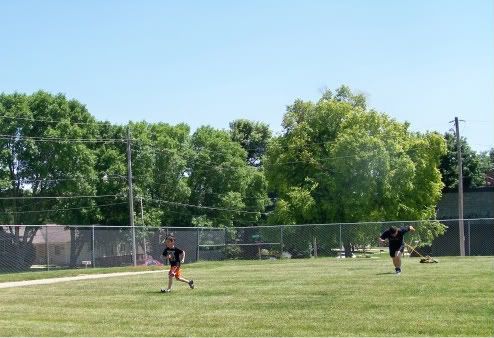
I bought an APT Pulling Harness - it is a solid piece of equipment and my son and I are enjoying testing it out on the field. The harness is on special now - three for the price of one! I bought the attached webbing, clip, and towing rope separately at a climbing store and Home Depot for about $15.
Thursday, July 16, 2009
Pulling Harness
I bought an APT Pulling Harness - it is a solid piece of equipment and my son and I are enjoying testing it out on the field. The harness is on special now - three for the price of one! I bought the attached webbing, clip, and towing rope separately at a climbing store and Home Depot for about $15.
Tuesday, July 14, 2009
The Importance of Reflection
One of the biggest behavioral mistakes I see among trainers and trainees alike, and people in general for that matter, is a lack of reflection following experiences. There is no asking "What went well/poorly?", "What good/bad decisions were made?", or "How can this be improved?".
Money - When was the last time you looked over your receipt from department store, read through the itemized list and said to yourself "Hmmm, that was a waste. I didn't really need that." or "That yogurt ended up uneaten and in the trash.", or "I wear that shirt a lot. I should buy more like it.". Until recently, I NEVER did that. Sure, I might have looked over my bank statements or balanced my checkbook once in a great while, but I had never gone down an itemized list of expenditures, scrutinizing each purchase. Since starting this practice, expenses have been much more manageable. I don't do it all the time, but when you're spending much more than you think you should, it's a good place to examine more closely.
Training - When was the last time you looked over your training log and thought to yourself "That really worked for me. I'll do it again and tweak it because I'm a little stronger in these areas now.", or "The last two weeks haven't been very impressive numbers-wise, but considering I had that big presentation at work, it's not bad. Let's see how I could improve this training plan to be more effective even while under a lot of work stress."? Most kids I know don't keep a training log and reflection never goes much beyond "Damn! That was hard!". A coach I had when I was 13 stressed the importance of keeping a training log - I haven't always been consistent about it, but I have logs from over 20 years ago, and just about every training session over the past 10+ years has been logged and looking them over is always educational.
Diet - I'll admit that I don't keep a food log. I have no interest in counting calories and calculating macros... In general, I'm not a picky eater and my diet is pretty clean. I do jot down notes from time to time about foods and restaurants that I really enjoy. When I dislike a food or restaurant, believe it or not, I try to understand why I don't like it - "Because it sucks." just isn't good enough for me. Is it the texture? Is it the smell? Is it the color? Is it the consistency? Especially when discovering "ethnic" foods that are unappealing, I think to myself "Millions of people eat this. Why don't I like it?".
The key to reflection is making every experience, good or bad, a learning experience. It ISN'T a self-flagellation session, nor is it high-fives all around. It is deep thought with a purpose, an eye toward future decisions and actions.
Wednesday, July 8, 2009
June 28 Tokyo Workshop

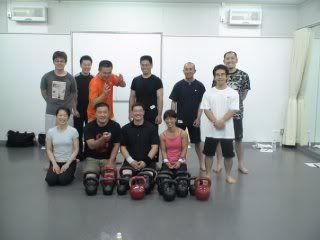
RKC Taikei Matsushita and I gave a workshop in Tokyo's Shinjuku district on June 28. Content, over 3.5 hours, covered mobility/flexibility drills, the swing, Turkish get-up, press/push-press/jerk, and the snatch. Jump stretch bands were used for a variety of stretches, mobility and activation drills, and complementary exercises. Two mini-workouts included a timed jerk (or push-press) set and and short snatch pace ladder workout for those competent w. their snatches.
There were 9 students in attendance and kettlebell experience ranged from a month to several years. They came from all over Japan, including one from Okinawa. A significant investment of time and money for many, and I was honored to teach them. To be honest, I was a little nervous teaching another person's students, many of whom had attended workshops with Senior RKC David Whitley, and Ken Black and John Wild Buckley - I was following in the (very large) footsteps of some very accomplished kettlebell teachers. However, many of the students improved their jerks significantly and Taikei was pleased that I introduced them to a variety of new mobility/flexibility drills and training methods. The new students were probably a bit overwhelmed at times, but their skills improved greatly in the short time alloted and they will need time and practice to digest the information. I look forward to hearing about their progress. Overall, I was very pleased with the students and my presentation of the materials. It was my first chance to teach kettlebells in Japanese and I was lucky to have Taikei there to help me out when I couldn't say "IT band", or "hip flexors" in Japanese. I know I was slaughtering the language at points - the highlight being when I said (in Japanese) "Put power in your butt!". I probably said that 10 times and didn't think about it until later. Hopefully Taikei won't put that on YouTube...
It was very nice to see Taikei Matsushita again - two years ago I traveled to Tokyo to visit him prior to my RKC certification. He gave me several pointers that improved the quality of my RKC experience greatly. Together, in addition to doing a lot of farmers walks transporting kettlebells to and from the workshop and working with an RKC candidate, we spent our time talking shop and eating good food. Good food and good company - can't beat that!
Wednesday, July 1, 2009
Some Kettlebell Art...
The workshop in Tokyo with RKC Taikei Matsushita was great! He has some wonderful students. We did a lot of mobility work, in addition to kettlebell basics and finished with a short timed snatch session. I will do a full write up this weekend.
For now, I'll leave you with my six year old's painting of a red kettlebell...

...and a glimpse inside dad's one-track mind.

For now, I'll leave you with my six year old's painting of a red kettlebell...
...and a glimpse inside dad's one-track mind.
Thursday, June 25, 2009
Presentation
My father can be very social, but he's not exactly a let's-share-feelings kind of guy. He doesn't really 'open-up'. Occasionally however, nostalgia will grab him and he'll relate a story or two. One of them involves a barbell... no, let me rephrase that - the barbell that he bought from a company called Eleiko in the late 60s. Whenever he tells me that story his eyes get a faraway look and a faint smile spreads over his face. He tells me about how balanced it was; how smoothly the sleeves rotated on the bar. He tells me how much it cost. He tells me about how it eventually snapped from misuse at the local university gym.
In the story he retells, the packaging the barbell came in is given as much attention as the barbell itself. And with good reason - packaging and presentation are as important as the product itself. Think of this in terms of food: if an inmate with a cigarette hanging from his mouth ladles some swill into a paper bowl and tosses it at you, will it taste worse or better than if a soup is served to you by an attentive and good looking waiter or waitress in a gourmet restaurant accompanied by pleasant ambiance and company you enjoy?


Pork chops. Which would you rather eat?
Packaging, in terms of training and coaching, is framing - rebooting or rearranging background knowledge and schemata so that new lessons can be learned, new skills practiced, and new strengths developed. Proper packaging helps the trainee to see the value and purpose in a program, exercise, or tool. It is not marketing per se, because some degree of buy-in is assumed here. Rather, it is an integral part of the lesson - previewing and priming the main course yet to come.

The following short list has ideas for packaging a training lesson. Modality is not fixed and mixing things up from time to time is recommended - using bodyweight or bands or freeweights, for example, or using a white board, chalk, or Power Point. The techniques, depending on time, content, and audience, may be the frame through which a lesson is viewed, or the bulk of the lesson itself.
Anecdotes
Pictures, Charts, Graphs, Visuals
Demonstrations
Video of Athletes
Activation/Isolation Exercises
Mobility Drills & Stretches
Analogies
Cues
Slow Motion
Reverse Engineering
Slogans/Sound Bytes
Success Stories
Statement of Purpose
Outlines
Pose A Problem
Simulation
Real-life Application
Coaches, how are you packaging what you are teaching? Are you ladling up swill? Or, are you sending an Eleiko olympic barbell in wooden box?
And, he tells me about how his Eleiko olympic barbell came in a box... a wooden box - like Cuban cigars, or a fine wine.
In the story he retells, the packaging the barbell came in is given as much attention as the barbell itself. And with good reason - packaging and presentation are as important as the product itself. Think of this in terms of food: if an inmate with a cigarette hanging from his mouth ladles some swill into a paper bowl and tosses it at you, will it taste worse or better than if a soup is served to you by an attentive and good looking waiter or waitress in a gourmet restaurant accompanied by pleasant ambiance and company you enjoy?
Packaging, in terms of training and coaching, is framing - rebooting or rearranging background knowledge and schemata so that new lessons can be learned, new skills practiced, and new strengths developed. Proper packaging helps the trainee to see the value and purpose in a program, exercise, or tool. It is not marketing per se, because some degree of buy-in is assumed here. Rather, it is an integral part of the lesson - previewing and priming the main course yet to come.
The following short list has ideas for packaging a training lesson. Modality is not fixed and mixing things up from time to time is recommended - using bodyweight or bands or freeweights, for example, or using a white board, chalk, or Power Point. The techniques, depending on time, content, and audience, may be the frame through which a lesson is viewed, or the bulk of the lesson itself.
Anecdotes
Pictures, Charts, Graphs, Visuals
Demonstrations
Video of Athletes
Activation/Isolation Exercises
Mobility Drills & Stretches
Analogies
Cues
Slow Motion
Reverse Engineering
Slogans/Sound Bytes
Success Stories
Statement of Purpose
Outlines
Pose A Problem
Simulation
Real-life Application
Coaches, how are you packaging what you are teaching? Are you ladling up swill? Or, are you sending an Eleiko olympic barbell in wooden box?
Sunday, June 21, 2009
Happy Father's Day!
I've probably posted this before, but I could post it everyday and never get tired of it...
Happy Father's Day!
Happy Father's Day!
Friday, June 19, 2009
Kettlebell Workshop In Tokyo
I'll be giving a kettlebell workshop in Tokyo on June 28th. RKC Taikei Matsushita is the host and it should be a great time. Main exercises to be covered will the Swing, the Turkish Get-Up, the Jerk, and the Snatch. In addition, we will also cover a lot of shoulder and hip mobility and activation drills, as well as many supplemental exercises as time permits.
I'm expecting a small and, relatively, well-practiced crowd - Taikei and I will be able to give a lot of personal attention. For three plus hours, it's a bargain if I do say so myself. I haven't talked to Taikei about it yet, but I'm hoping to do some Karaoke afterwards!!!

Details (in Japanese): http://www.kettlebell.jp/seminar/
(in English): http://swingsnatch.blogspot.com/2009/06/kettlebell-workshop.html
I'm expecting a small and, relatively, well-practiced crowd - Taikei and I will be able to give a lot of personal attention. For three plus hours, it's a bargain if I do say so myself. I haven't talked to Taikei about it yet, but I'm hoping to do some Karaoke afterwards!!!
Details (in Japanese): http://www.kettlebell.jp/seminar/
(in English): http://swingsnatch.blogspot.com/2009/06/kettlebell-workshop.html
Thursday, June 18, 2009
"Enough"
True story, Word of Honor:
Joseph Heller, an important and funny writer now dead, and I were at a party given by a billionaire on Shelter Island.
I said, "Joe, how does it make you feel to know that our host only yesterday may have made more money than your novel 'Catch-22' has earned in its entire history?"
And Joe said, "I've got something he can never have."
And I said, "What on earth could that be, Joe?"
And Joe said, "The knowledge that I've got enough."
Not bad! Rest in peace!"
-Kurt Vonnegut
(from Bob Sutton, the author of "The No Asshole Rule")
The gym scene in Japan, overall, is terrible. Especially in rural settings, finding a gym with free weights is difficult. Even when you do, olympic barbells and squat racks are almost non-existent. Often gyms will require initiation fees; it's rare to find gyms with a reasonable daily fee.
Once again, I find myself in the land of the rising sun, trying to stay in shape. Space is a precious commodity here. Even in rural areas, you'd be hard pressed to come across unused floor space or ground.
Years ago now, I bought a 28kg kettlebell and I do the bulk of my training with it while I'm in Japan. My "gym" is right here (between the Nissan and the Toyota):
The view from my training space is, thankfully, not a neighbor's front window, but a small park:
I often do pull-ups off the slide in the park, and I can use the Jump Stretch bands I brought with me for a variety of exercises and mobility drills. Most of my workouts include jerks and snatches, pull-ups, push-ups, bodyweight Bulgarian split squats, or walking swings. I've done the following complex a few times now, and I find that it leaves me feeling good and limber:
1 one-arm kb clean to 1 kb jerk to 1 overhead squat (right)
1 one-arm kb clean to 1 kb jerk to 1 overhead squat (left)
2 one-arm kb cleans to 2 kb jerks to 2 overhead squats (right)
2 one-arm kb cleans to 2 kb jerks to 2 overhead squats (left)
3 one-arm kb cleans to 3 kb jerks to 3 overhead squats (right)
3 one-arm kb cleans to 3 kb jerks to 3 overhead squats (left) etc...
You don't put the bell down at all - any rest is going to be done in the rack and overhead positions. The record (for now) is finishing 5 reps w. a 28kg bell (that's all I have right now). Ten is probably a good goal. This complex is a variation of the clean and squat combo that Dan John introduced in the thread Kbell Dbl Clean to Dbl Front Squat.
I am forced to do, with less. But I find that it is "enough". More than enough actually. And with less distraction from the myriad of options I have at home, I find it easier to notice the small and simple pleasures surrounding my "gym"...
Monday, June 15, 2009
Wednesday, June 10, 2009
Breathing
In crucial moments, breathing involuntarily comes to a stop. The circus performer knows this, the athlete knows it, the potter throwing a bowl on the wheel knows it, and so does the cartographer, who unconciously holds his breath when he wants to draw a fine and accurate line. In the tea ceremony, in Noh acting, in judo, and in kendo, the tanden takes the lead in the movements of the body. We have already described how the artist or the calligrapher almost stops breathing when he draws a series of lines and gives new tension to the respiratory muscles every time he comes to an important point. He actually practices what we have called intermittent, or bamboo, exhalation. An elevated type of spiritual activity is manifested in this breathing.
Our contention, then, is that controlled respiration generates spiritual power, and that attention, which is actually spiritual power, can never be exercised without tension in the tanden.
- Katsuki Sekida
Of all the Squat Rx videos I've made, I thought this one, "Breathing & Set-Up" was particularly well done. Except for some notes, I don't script the videos out and it probably shows but, I think the information presented was very good. The idea of breath control in athletics is often overlooked and I was happy I included it in the series. For some people, this is all common sense. For others (like me), it's only after years of unnecessarily painful practice that you come to figure out the subtle nuances. I've had many people report PRs after seeing this video and that's always nice to hear.
Suggested further reading:
The Naked Warrior by Pavel Tsatsouline
Power To The People by Pavel Tsatsouline
Zen Training: Methods and Philosophy by Katsuki Sekida
Sunday, June 7, 2009
Maccha - The Secret Ingredient To The World's Best Protein Shake


Maccha (pronounced "MAH-CHAH") is green tea powder - the kind used for the tea ceremony in Japan. It is a very fine powder, mixed directly into hot water to make tea. It is amazing as a tea, but it is also great as a spice/flavoring. In Japan, it is used in a wide variety of foods from candy and chocolates to meat and rice dishes.

My all-time favorite protein shake is made in a blender with the following ingredients:
*maccha
*vanilla flavored protein powder
*milk
*ice
*vanilla ice cream
*frozen fruit (optional)
Thursday, June 4, 2009
Renewal
"Eliminate the old and useless so that the new can be seen. You must wait for the right moment to act, when the snake is ready to shed its skin and the sun is approaching the zenith. When the right moment arrives, act with confidence. You will be linked to the spirits and they will carry you through. This begins a whole new cycle of time. All your doubts and sorrows will be extinguished."
- I Ching
Subscribe to:
Posts (Atom)